Why Companies Are Re-Checking Employees After Hiring
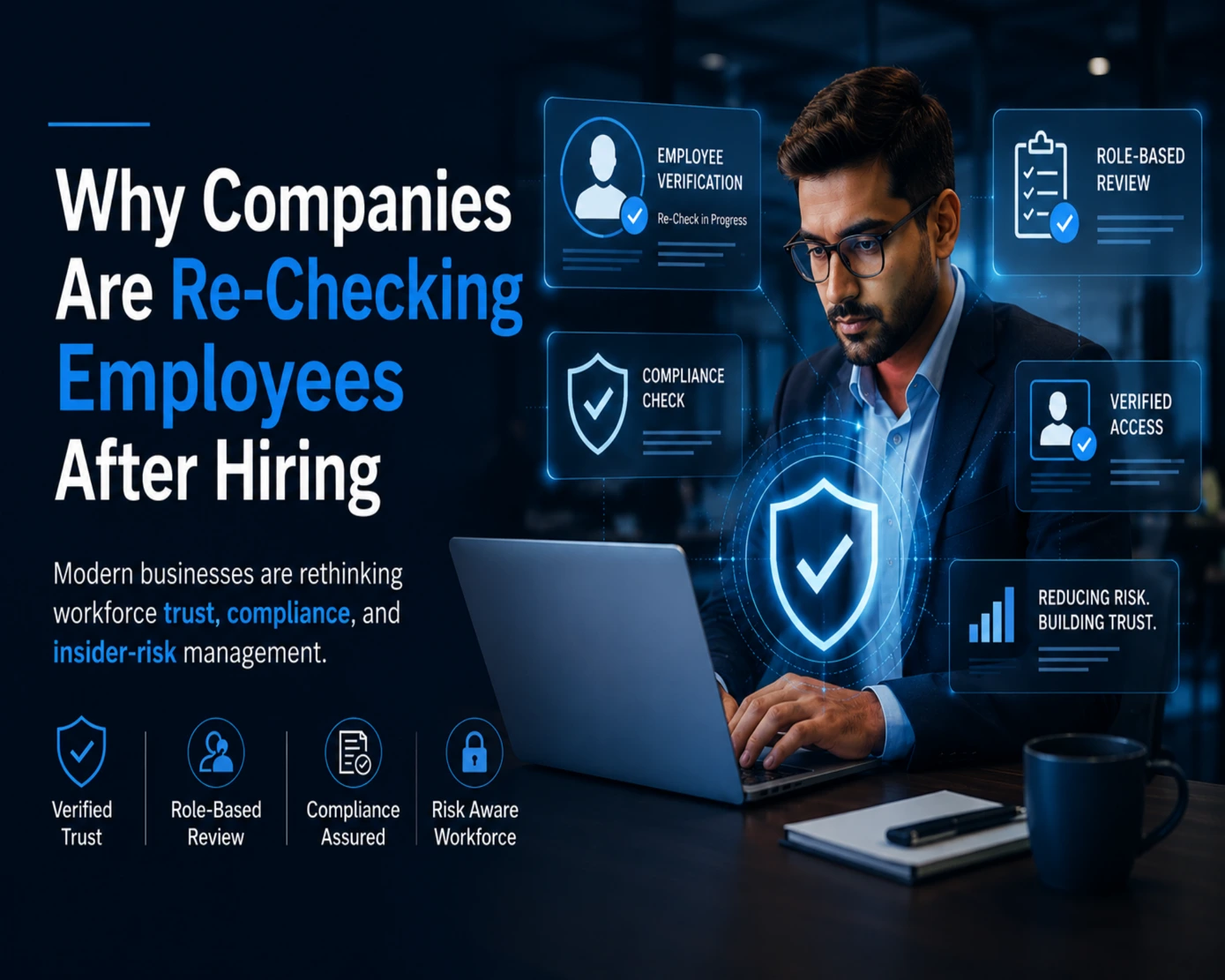
In today’s hiring environment, verification is no longer ending on the employee’s first day at work. Companies across industries are beginning to revisit employee records, role-based access, and compliance status even after onboarding is complete.
For many HR leaders and founders, this shift is not about mistrust — it is about changing business realities. Remote work, insider-risk concerns, client compliance expectations, and increasing access to sensitive systems have forced organizations to rethink how workforce trust is managed over time.
As a result, employee re-verification is gradually becoming part of modern governance strategies rather than an occasional HR exercise.
Hiring Verification Is No Longer a One-Time Activity
For years, most organizations treated background verification as a pre-joining formality. Once the employee cleared the hiring process, verification was considered complete. That approach is rapidly changing.
Today, companies are beginning to re-check employees even after onboarding — not because they suddenly distrust their workforce, but because workplace risk has evolved. Remote work, data access, compliance pressure, insider threats, and client expectations have changed how organizations think about employee credibility.
The idea that a single verification at the time of joining is enough for an employee’s entire career no longer aligns with how modern businesses operate.
Why Employee Re-Verification Is Increasing
Organizations now operate in environments where employee responsibilities change quickly. Someone hired into a mid-level operational role may later gain access to financial systems, confidential client information, strategic business data, or leadership authority.
As responsibility increases, so does risk exposure.
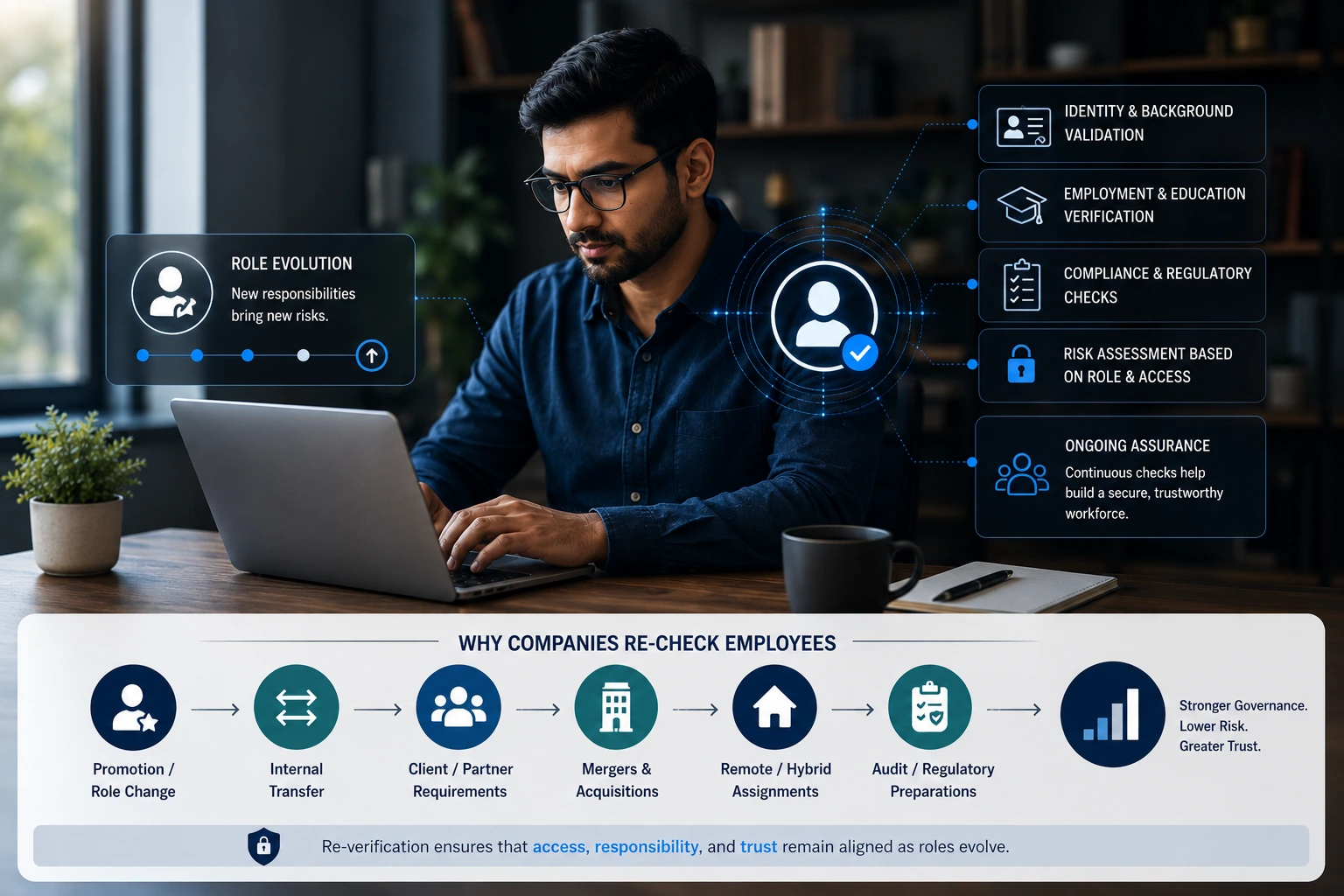
This shift has pushed companies to revisit employee verification during:
-
Promotions into sensitive roles
-
Internal transfers
-
Client-driven compliance reviews
-
Mergers and acquisitions
-
Long-term remote or hybrid assignments
-
Regulatory or audit preparation
Re-verification is becoming part of workforce governance rather than an exceptional process.
The Rise of Insider Risk Awareness
One of the biggest reasons companies are re-checking employees is the growing awareness of insider risk. Businesses have realized that not all threats come from outside attackers or external fraud. Some of the most damaging incidents originate internally — often from individuals who already have trusted access.
This does not mean organizations assume employees are dishonest. It means leadership understands that risk changes over time. Employees may take on undisclosed external work, develop conflicts of interest, misuse access privileges, or face legal or financial issues that affect their role suitability.
Without periodic verification, these risks often remain invisible until an incident occurs.
Remote Work Changed the Trust Model
Remote and hybrid work models accelerated this shift significantly. In traditional office environments, visibility acted as an informal control. Managers observed attendance, interactions, and behavior naturally.
Remote work removed many of those signals.
Organizations now rely more heavily on digital access, distributed teams, and independent accountability. As a result, employers are strengthening formal controls around workforce verification and access governance.
Re-checking employees in remote environments is increasingly viewed as a preventive business practice rather than an aggressive monitoring tactic.
Why Clients and Auditors Are Driving Re-Verification
Many companies are not conducting re-verification solely for internal reasons. Enterprise clients, global partners, and regulated industries are raising expectations around workforce due diligence.
Clients want assurance that the people handling their data, systems, or operations remain compliant and trustworthy — not just at the time of hiring, but throughout the engagement lifecycle.
Similarly, auditors increasingly evaluate whether organizations have ongoing people-risk controls instead of one-time hiring checks.
This external pressure is making re-verification more common across IT services, BFSI, staffing, healthcare, consulting, and outsourcing industries.
Employee Re-Verification Is Not About Surveillance
A major misconception around re-verification is that it reflects mistrust toward employees. In reality, well-managed organizations apply re-verification selectively, transparently, and role-wise.
The objective is not surveillance. The objective is alignment between:
-
access,
-
responsibility,
-
and verified trust.
When done properly, re-verification protects both the organization and the employee by ensuring that governance standards remain consistent as roles evolve.
Common Areas Companies Re-Check
Modern employee re-verification is usually targeted rather than repetitive. Organizations often focus on:
-
Employment status validation
-
Conflict-of-interest disclosures
-
Criminal record updates (where legally applicable)
-
Address and identity updates
-
Compliance-related declarations
-
Role-based risk reassessment
The scope depends on business needs, industry standards, and role sensitivity.
Why Smart Companies Communicate Re-Verification Clearly
The success of employee re-verification depends heavily on communication. Employees are far more cooperative when organizations explain:
-
why checks are being conducted,
-
what information is involved,
-
and how data will be protected.
Companies that communicate openly create far less resistance than organizations that introduce re-checks suddenly or without context.
Transparency transforms re-verification from a suspicious activity into a professional governance process.
The Business Advantage of Ongoing Verification
Organizations that conduct structured employee re-verification gain advantages beyond compliance.
They:
-
reduce insider-risk exposure,
-
strengthen client trust,
-
improve audit readiness,
-
maintain cleaner governance records,
-
and make leadership decisions more confidently.
In competitive industries, these controls also strengthen reputation and operational credibility.
Why This Trend Will Continue Growing
Employee verification is evolving from a hiring task into a long-term workforce integrity strategy.
As businesses become more digital, distributed, and compliance-driven, organizations will continue investing in systems that validate trust over time — not just on the first day of employment.
Companies that adapt early will face fewer surprises, fewer governance gaps, and stronger stakeholder confidence.
Final Thought
Re-checking employees after hiring is not a sign that trust is disappearing. It is a sign that organizations are becoming more aware of how people risk evolves over time.
The modern workplace changes quickly. Access changes. Responsibilities change. Business exposure changes.
Smart organizations understand that verification should evolve too.
Trust may begin during hiring — but responsible companies continue validating it as the business grows
Leave a comments