Why Your Best Performer Can Still Be a Hiring Risk
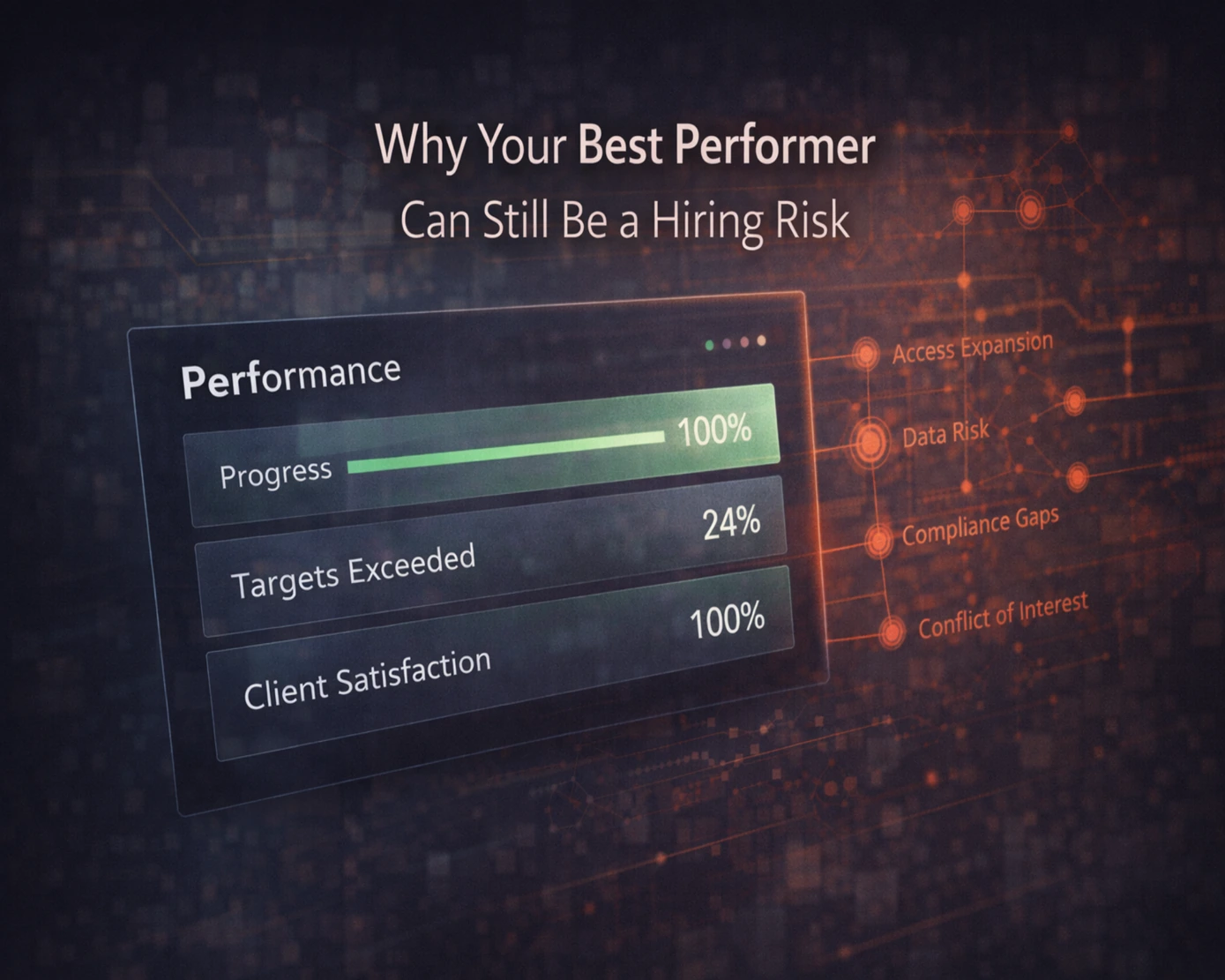
Performance Often Hides Risk, Not Eliminates It
High performers are usually the last people organizations question. They deliver results, meet targets, impress clients, and are often promoted quickly. Over time, performance becomes a shield — protecting individuals from scrutiny that others are routinely subjected to.
This is where risk quietly builds. Performance measures output, not integrity, compliance, or long-term exposure. When organizations equate results with reliability, they create blind spots that only surface during incidents.
Why High Performers Are Trusted Too Much
Strong performers earn trust quickly. Managers depend on them, teams rely on them, and leadership hesitates to disrupt momentum. As a result, checks that apply to others are often relaxed or skipped.
This trust is rarely intentional favoritism. It is convenience mixed with optimism. The problem is that trust without verification scales risk along with responsibility.
Risk Increases With Access, Not With Tenure
The more successful an employee becomes, the more access they receive — systems, data, financial authority, clients, and decision-making power.
If early assumptions about background, conduct, or conflicts were never independently validated, that access multiplies exposure. Issues that were harmless at junior levels become serious risks at senior or sensitive roles.
People risk grows with access, not just time.
Common Risks Hidden Behind Strong Performance
Some of the most damaging people-risk incidents involve high performers. These include:
-
Undisclosed conflicts of interest
-
Parallel employment or advisory roles
-
Data misuse under pressure to deliver
-
Bypassing controls “to get things done”
-
Behavioral issues overlooked due to results
None of these show up in performance metrics — until they cause harm.
Promotions Often Skip Re-Verification
One of the most common governance gaps occurs during promotions. Employees move into leadership, finance, compliance, or client-critical roles without any reassessment of risk.
Organizations assume that past success equals continued trustworthiness. In reality, promotions change risk exposure and should trigger reassessment — not blind continuity.
Why Managers Resist Questioning Top Talent
Managers fear losing momentum, damaging relationships, or appearing distrustful. HR teams sometimes hesitate to raise concerns about high performers due to internal politics.
This hesitation is understandable — but dangerous. When issues eventually surface, organizations are often asked why warning signs were ignored for so long.
Silence is rarely defensible after the fact.
How Background Verification Fits This Reality
Background verification is not about questioning performance — it is about validating trust as responsibility increases.
Re-verification during promotions, role changes, or access expansion helps organizations:
-
Reconfirm employment integrity
-
Identify conflicts of interest
-
Ensure compliance readiness
-
Document due diligence
This protects both the company and the employee.
Leadership’s Role in Managing High-Performer Risk
Leadership must create an environment where governance applies to everyone — especially top talent. When leaders support consistent standards, HR can act without fear of backlash.
Strong leaders understand that protecting high performers from scrutiny does not protect the organization — it exposes it.
Culture Is Defined by What You Allow
When employees see that performance exempts some people from controls, culture erodes. Standards feel negotiable. Accountability weakens.
When standards apply consistently, trust actually increases — because fairness becomes visible.

Final Thought
Being a top performer does not eliminate risk — it often amplifies it.
Organizations that manage people risk responsibly do not penalize success. They ensure that trust, access, and accountability grow together.
Performance earns opportunity. Verification protects trust.
Leave a comments