Why Startups Fail Due to Bad Hiring Decisions (And How Background Verification Prevents It)
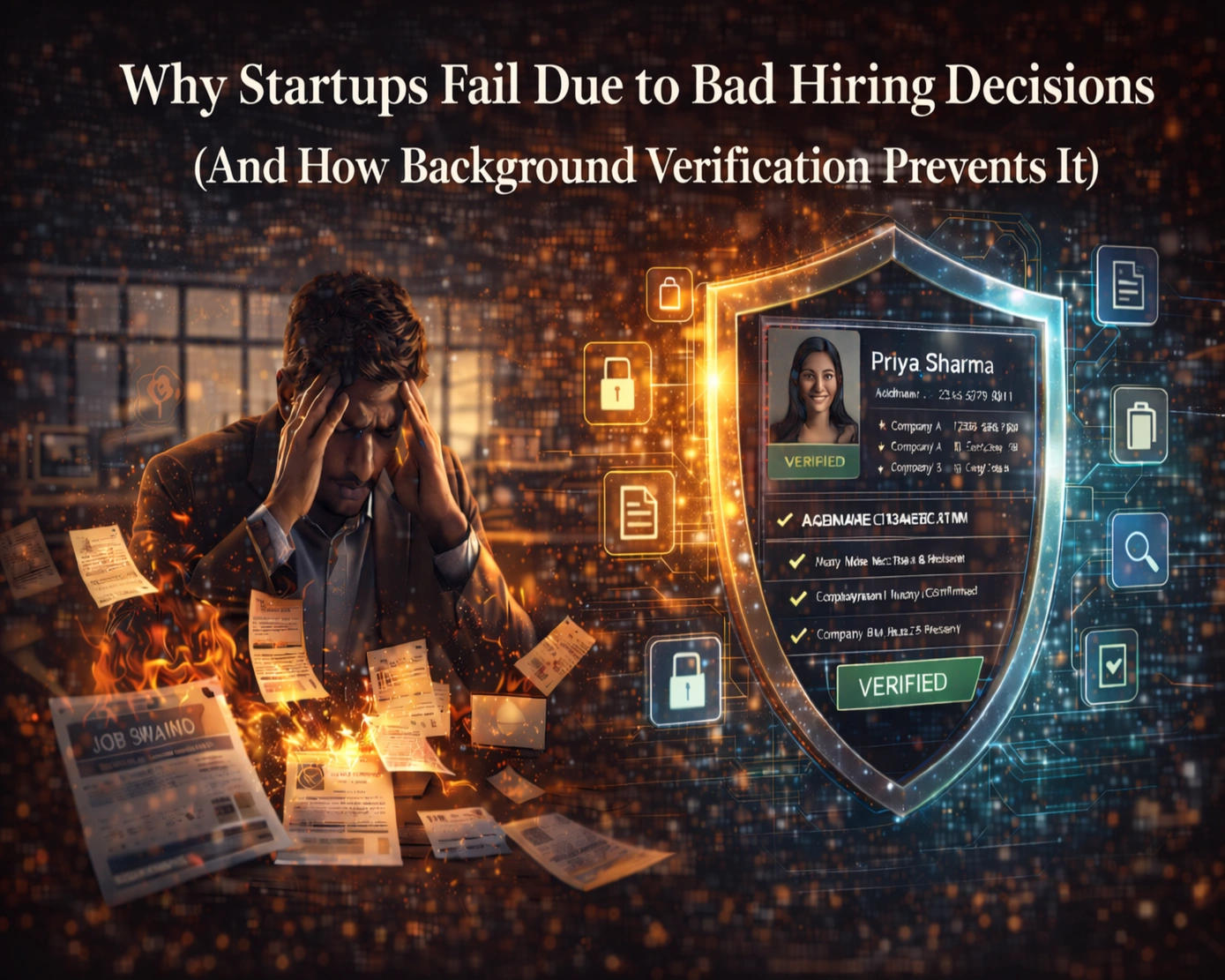
Startup Failure Rarely Starts With the Product
When startups fail, the blame is usually placed on product-market fit, funding, or competition. What is discussed far less — but felt deeply by founders — is how often failure begins with bad hiring decisions.
In early-stage and scaling startups, every hire has outsized impact. One wrong person in a key role can derail execution, damage culture, break client trust, or expose the company to compliance and data risks. By the time the problem becomes visible, recovery is often expensive or impossible.
Why Startups Are More Vulnerable to Hiring Mistakes
Startups operate under pressure — tight timelines, limited budgets, and aggressive growth targets. Hiring decisions are often made quickly, based on trust, referrals, or interview performance alone.
Unlike large enterprises, startups lack redundancy. There are fewer layers to absorb mistakes. A mis-hire is not isolated; it affects founders directly — emotionally, operationally, and financially.
Remote hiring and distributed teams in 2026 have further increased this vulnerability, making it harder to validate candidates through informal means.
Common Hiring Mistakes That Hurt Startups
Bad hiring in startups rarely looks dramatic at first. It usually shows up as:
-
Founders hiring “potential” without validating experience
-
Trusting referrals without verification
-
Ignoring red flags to close roles quickly
-
Hiring senior talent without role-fit clarity
-
Overlooking compliance and data access risks
Many founders later realize that the candidate was not dishonest in interviews — just not what the startup actually needed.
When Bad Hiring Turns Into Business Risk
A wrong hire does more than slow progress. It can:
-
Delay product delivery
-
Create technical debt
-
Cause client dissatisfaction
-
Leak sensitive data or IP
-
Trigger internal conflict
-
Drain leadership bandwidth
For startups, time lost to fixing hiring mistakes is often more damaging than money lost.
Why Interviews Alone Don’t Protect Startups
Founders often rely heavily on instinct and interviews. While intuition matters, it cannot replace verification.
Candidates can interview well, especially in remote settings. Resumes can be polished. References can be friendly. None of these confirm whether the experience, integrity, or accountability required for startup roles actually exists.
This is where many startups underestimate risk — assuming trust will compensate for verification.
How Background Verification Protects Startup Growth
Background verification provides startups with early clarity, not bureaucracy.
Employment verification confirms whether experience claimed is real and relevant. Education verification validates foundational skills. Reference insights reveal behavior patterns that interviews miss. Identity and address checks establish accountability — critical when teams are remote.
Verification does not slow startups down when done right. It prevents founders from scaling problems instead of teams.
The Myth That “BGV Is Only for Enterprises”
One of the most damaging beliefs in startup hiring is that background verification is only needed at scale. In reality, startups need it more, not less.
Enterprises can absorb a few bad hires. Startups cannot. One wrong person in engineering, finance, or customer delivery can undo months of progress.
BGV is not about mistrust — it is about protecting limited runway and founder focus.
Leadership Accountability in Startup Hiring
In startups, hiring decisions reflect directly on founders. There is no HR buffer, no governance committee to hide behind. When something goes wrong, accountability sits squarely with leadership.
Founders who treat hiring as a risk decision — not just a growth activity — build stronger, more resilient companies.

Final Thought
Startups rarely fail because they hired too carefully. They fail because they hired too fast, trusted too easily, and verified too late.
Background verification gives founders clarity in a world full of assumptions. It helps startups scale people responsibly — before mistakes become fatal.
In startups, hiring is not an HR task. It is a survival decision.
Leave a comments