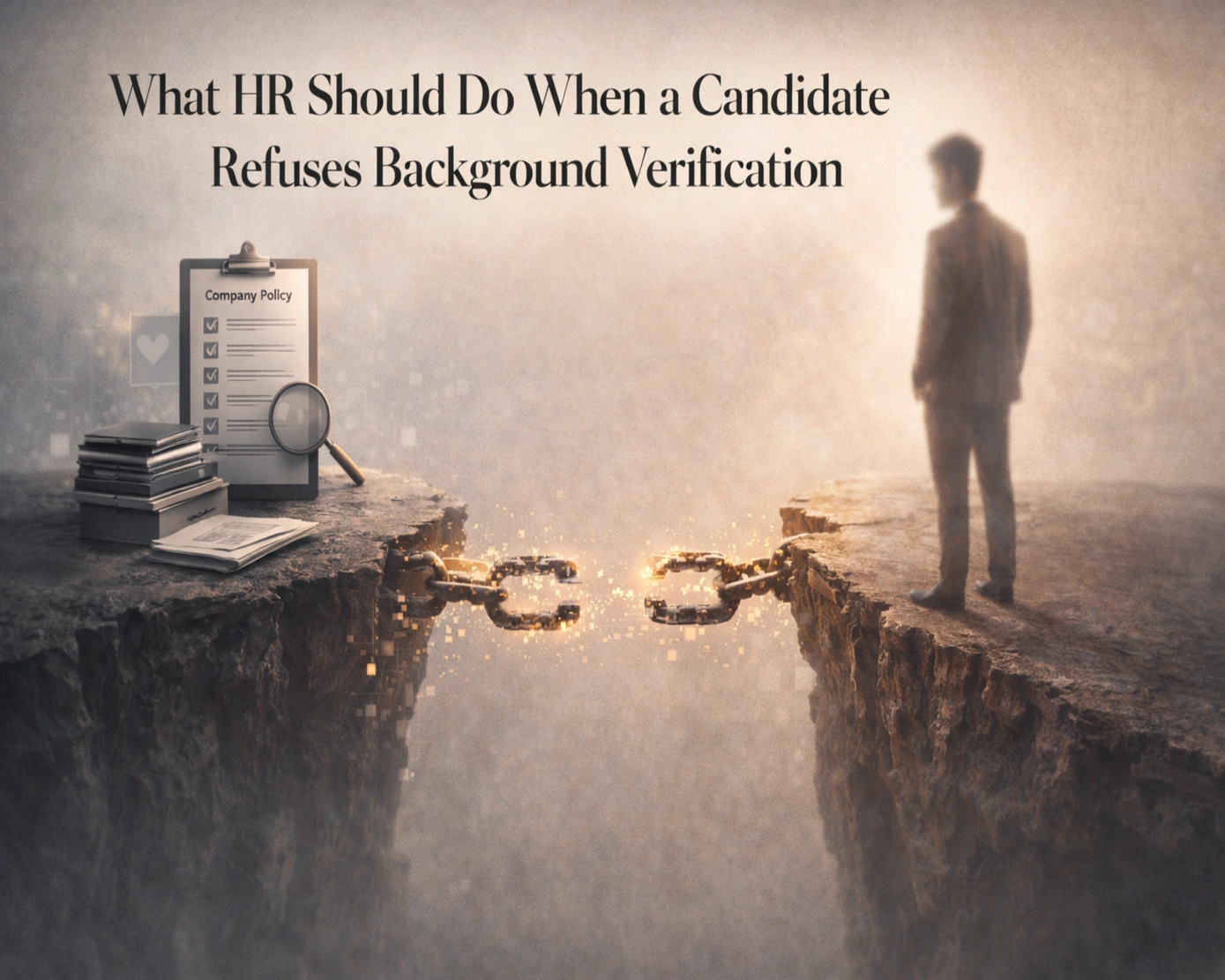
What HR Should Do When a Candidate Refuses Background Verification
Why This Situation Is More Common Than HR Expects
Most HR leaders assume that candidates who clear interviews will automatically agree to background verification. In practice, refusals happen more often than expected — sometimes politely, sometimes defensively, and sometimes without explanation.
A candidate may refuse background verification due to privacy concerns, fear of past discrepancies being uncovered, misunderstanding of the process, or advice from peers. Regardless of the reason, how HR responds in this moment matters far more than the refusal itself.
Handled poorly, it can lead to complaints, lost talent, or internal confusion. Handled professionally, it becomes a clear decision point that protects the organization.
First, Understand What “Refusal” Actually Means
A refusal does not always mean outright rejection of verification. Often, it appears as hesitation, delay, selective consent, or repeated questions meant to stall the process.
Some candidates are comfortable sharing documents but uncomfortable with employer contact. Others object to criminal checks or third-party involvement. HR must first determine whether the candidate is refusing verification entirely or resisting specific components.
This distinction is critical before taking any action.
Why Candidates Refuse Background Verification
Understanding motivation helps HR respond calmly rather than reactively.
Some candidates genuinely misunderstand the scope and fear misuse of their data. Others may have informal employment histories, employment gaps, or documentation issues they are unsure how to explain. In some cases, refusal is intentional — driven by fake experience, moonlighting, or undisclosed issues.
HR should not assume intent immediately, but should also not ignore the risk.
How HR Should Respond — Step by Step
The first response should always be clarity, not confrontation. HR should explain:
-
Why background verification is required
-
What information will be checked
-
How data will be handled and protected
-
Who will conduct the verification
Clear explanation alone resolves many refusals.
If the candidate still hesitates, HR should ask what specifically concerns them. This opens a dialogue instead of creating defensiveness.
All communication should be documented.
When Refusal Becomes a Risk Signal
If a candidate continues to refuse verification after clear explanation and reassurance, it becomes a risk indicator — not because refusal is illegal, but because verification is a standard control in professional hiring.
Organizations must ask themselves a simple question:
Are we comfortable hiring this person without independent validation?
For most roles, especially those involving data access, finance, clients, or compliance, the answer is no.
Can HR Proceed Without Background Verification?
Technically, an organization can choose to proceed. Practically, doing so introduces accountability risk.
If an issue arises later — fraud, misconduct, client escalation — leadership will be asked whether due diligence was exercised. “The candidate refused verification” is rarely seen as a strong defense.
This is why most organizations treat refusal as a hiring blocker rather than a negotiable preference.
How to Decline the Candidate Professionally
If the decision is to not proceed, communication must be respectful and neutral. HR should avoid language that sounds accusatory or judgmental.
A professional response focuses on policy, not suspicion. For example, stating that verification is a standard hiring requirement applied uniformly avoids personalizing the decision.
This protects employer brand and reduces the risk of disputes or complaints.
Why Consistency Is Critical
The biggest risk for HR is inconsistency. Allowing one candidate to bypass verification while enforcing it for others creates governance and fairness issues.
If verification is mandatory for the role, refusal must have the same outcome every time. Consistency protects HR, leadership, and the organization as a whole.
What Leadership Should Understand
Candidate refusal of background verification is not an HR inconvenience — it is a risk decision. Leadership alignment is essential so HR teams are not pressured to “make exceptions” under hiring urgency.
Clear policies and leadership backing empower HR to act decisively and fairly.

Final Thought
A candidate refusing background verification is not automatically a bad candidate — but hiring without verification is always a risk.
Professional HR teams respond with clarity, transparency, and consistency. When refusal persists, walking away is often the safest and most defensible decision.
In hiring, trust is important — but unchecked trust is a liability.
Leave a comments